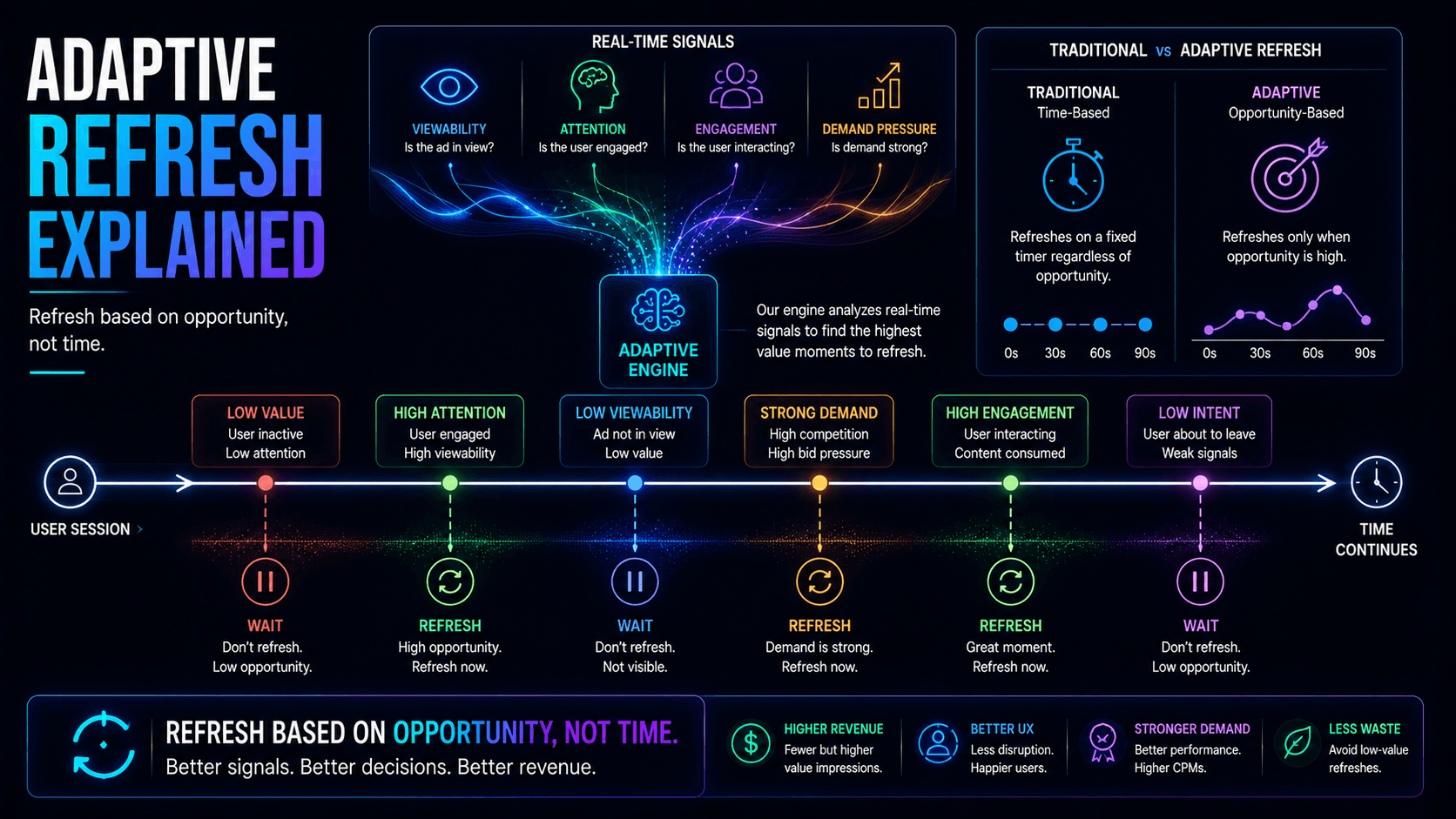
Adaptive Refresh Explained
For years, ad refresh strategies followed a simple rule.
Wait a fixed amount of time.
Refresh the ad.
Repeat.
The approach was easy to implement and easy to measure.
Unfortunately, it ignored one important reality.
Not every impression has the same value.
Refreshing inventory on a fixed timer assumes that every user, every page, and every moment creates the same opportunity.
In practice, they do not.
This is why adaptive refresh has become one of the most important concepts in modern yield optimization.
Instead of refreshing ads based on time alone, adaptive refresh responds to opportunity.
What Is Ad Refresh?
Ad refresh is the process of requesting a new advertisement within an existing placement without requiring the user to reload the page.
The goal is simple.
Create additional monetization opportunities from users who remain engaged with content.
For example:
- A user spends three minutes reading an article.
- The ad placement remains visible.
- The publisher requests a new auction.
- A new advertisement is served.
When implemented correctly, refresh can increase revenue while preserving user experience.
When implemented poorly, it can reduce inventory quality and weaken demand.
The Problem With Fixed Timers
Many refresh implementations use rules such as:
- Refresh every 30 seconds
- Refresh every 45 seconds
- Refresh every 60 seconds
These rules are simple.
They are also blind.
The timer does not know:
- Whether the ad is visible
- Whether the user is engaged
- Whether demand is strong
- Whether the placement is worth refreshing
As a result, refreshes often occur when inventory value is low.
This creates unnecessary auctions and weak impressions.
Opportunity Is Not Constant
Imagine two users.
The first user:
- Is actively reading
- Has spent two minutes on the page
- Keeps the ad in view
- Continues scrolling naturally
The second user:
- Switched tabs
- Stopped interacting
- Is about to leave
A timer-based system treats both users identically.
An adaptive system does not.
Adaptive refresh recognizes that the first opportunity is far more valuable than the second.
How Adaptive Refresh Works
Instead of monitoring time alone, adaptive refresh evaluates signals.
Common signals include:
Viewability
Is the placement currently visible?
A refresh should rarely occur if the user cannot see the ad.
Attention
Is the user actively engaged with the content?
Attention often provides a stronger indication of value than simple visibility.
User Engagement
Signals may include:
- Scroll activity
- Reading behavior
- Time on page
- Interaction depth
Engaged users typically create stronger advertising opportunities.
Demand Conditions
Strong competition can increase the value of a refresh opportunity.
Weak competition may suggest waiting for a better moment.
Refresh When Value Peaks
The core idea behind adaptive refresh is simple.
Refresh inventory when value is highest.
Instead of:
Refresh every 30 secondsThe strategy becomes:
Refresh when viewability is strong
Refresh when attention is high
Refresh when demand is active
This approach creates fewer but more valuable auctions.
Benefits of Adaptive Refresh
Higher Revenue Quality
Adaptive refresh prioritizes stronger opportunities rather than creating more inventory.
Better User Experience
Fewer unnecessary refreshes reduce visual noise and preserve the reading experience.
Stronger Advertiser Performance
Advertisers benefit from higher-quality impressions and better engagement.
Reduced Inventory Waste
Low-value refreshes are avoided.
This protects inventory quality over time.
Common Mistakes
Refreshing Hidden Ads
If a user cannot see the placement, refreshing it rarely creates value.
Ignoring Engagement
Time alone is not a reliable indicator of opportunity.
Refreshing Too Frequently
Excessive refresh rates can create demand fatigue and lower CPMs.
Optimizing Only for Volume
More auctions do not automatically create more revenue.
Opportunity matters more than quantity.
The Future of Refresh
Modern monetization systems increasingly treat refresh as a decision rather than a timer. Advances in attention measurement, viewability prediction, and behavioral analysis allow publishers to identify the moments when inventory is most valuable.
This transforms refresh from a mechanical process into an intelligent optimization strategy.
The result is better inventory quality, stronger advertiser outcomes, and more sustainable revenue growth.
Conclusion
Traditional refresh strategies focus on time.
Adaptive refresh focuses on opportunity.
By incorporating viewability, attention, engagement, and demand signals, publishers can create fewer but higher-value auctions.
The goal is not to refresh more often. The goal is to refresh at the right moment. Because the best opportunities are not created by a timer.
They are created by user behavior.