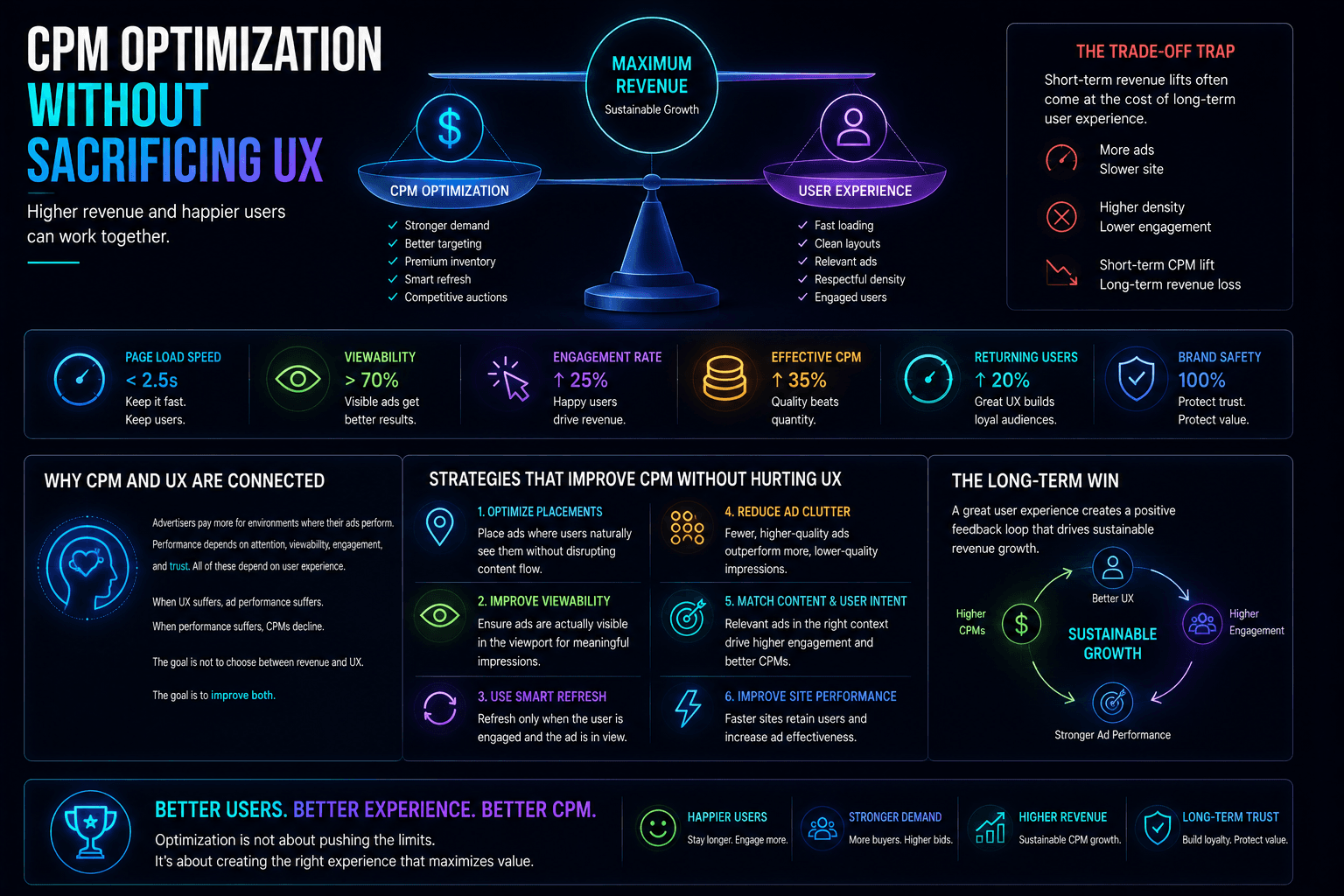
Many publishers believe they must choose between revenue and user experience.
The assumption is simple.
More aggressive monetization generates more revenue.
A cleaner experience generates happier users.
Therefore, improving one must come at the expense of the other.
In reality, the opposite is often true.
The highest-performing publishers understand that user experience is not a constraint on revenue. It is one of the primary drivers of revenue.
The goal is not to maximize CPM at any cost.
The goal is to maximize value for users, advertisers, and publishers simultaneously.
The False Trade-Off
Short-term monetization decisions often create the illusion of success.
Examples include:
- Adding more placements
- Increasing refresh frequency
- Expanding sticky inventory
- Reducing auction quality controls
- Allowing intrusive formats
These tactics can sometimes produce an immediate increase in impressions or revenue.
However, they often create long-term problems:
- Lower engagement
- Reduced session depth
- Faster exits
- Banner blindness
- Lower advertiser performance
Revenue grows temporarily while inventory quality declines.
Eventually advertisers notice.
Users notice.
The market adjusts.
Why Advertisers Care About User Experience
Advertisers do not buy impressions.
They buy outcomes.
Those outcomes depend heavily on user experience.
A cluttered page creates:
- Lower attention
- Reduced engagement
- Weaker brand recall
- Lower conversion rates
A fast, well-structured page creates:
- Better visibility
- Stronger attention
- Higher interaction rates
- More effective campaigns
This is why premium publishers often command premium CPMs.
The audience experience itself becomes part of the value proposition.
The Relationship Between UX and CPM
Several user experience factors directly influence monetization performance.
Page Speed
Slow pages hurt everyone.
Users leave sooner.
Advertisers lose opportunities.
Auction participation decreases. Improving page performance often improves both engagement and monetization.
Layout Stability
Unexpected content movement creates frustration. Excessive layout shifts reduce trust and make content harder to consume. Stable layouts improve both usability and ad performance.
Attention
Attention is one of the strongest indicators of advertising value. When users remain engaged with content, inventory becomes more attractive to buyers. Attention is generated by experience quality. Not by ad density.
Content Consumption
Longer sessions typically create more monetization opportunities. Publishers should optimize for meaningful engagement rather than maximizing short-term impressions.
The Most Effective CPM Optimization Strategies
The strongest CPM improvements usually come from quality improvements rather than volume increases.
Improve Placement Quality
Placement quality often matters more than placement quantity. Premium placements tend to generate:
- Better viewability
- Higher engagement
- Stronger competition
A single premium placement can outperform several weaker ones.
Increase Viewability
Advertisers value inventory that users can actually see. Improving viewability often increases auction competition and bid quality. However, viewability should be balanced with attention and engagement rather than treated as the only optimization target.
Optimize Refresh Intelligently
Adaptive refresh strategies can increase inventory value while avoiding unnecessary auctions.
Refresh should occur when:
- Attention is high
- Viewability is strong
- Demand conditions are favorable
Not simply when a timer expires.
Reduce Clutter
Removing low-performing placements can sometimes increase total revenue.
Fewer distractions often create stronger attention and better advertiser outcomes.
Match Advertising to Context
Relevance matters.
Ads that align with content, audience intent, and page context generally perform better than generic inventory.
Sustainable Monetization Wins
The most successful publishers think beyond immediate CPMs.
They focus on:
- Retention
- Loyalty
- Attention
- Engagement
- Inventory quality
These factors create a positive feedback loop. Better experience leads to better attention. Better attention leads to stronger advertiser performance. Stronger performance attracts more demand. More demand improves CPMs.
The result is sustainable growth rather than temporary gains.
Warning Signs That UX Is Being Sacrificed
Publishers should regularly evaluate whether monetization decisions are creating hidden costs.
Common warning signs include:
- Rising bounce rates
- Shorter sessions
- Lower engagement
- Increased layout shifts
- User complaints
- Falling advertiser performance
These signals often appear before revenue declines become obvious.
A Better Framework
Instead of asking:
"How can we increase CPM?"
Ask:
"How can we increase the value of the experience?"
When user experience improves, many monetization metrics improve naturally.
The strongest optimization strategies focus on creating better opportunities rather than creating more opportunities.
Conclusion
CPM optimization and user experience are not opposing goals.
They are deeply connected.
Advertisers pay more for inventory that performs well.
Inventory performs well when users remain engaged.
Publishers that focus on speed, attention, relevance, layout quality, and engagement often achieve stronger CPMs than those relying on aggressive monetization tactics.
The best long-term strategy is not to choose between revenue and user experience.
It is to improve both together.