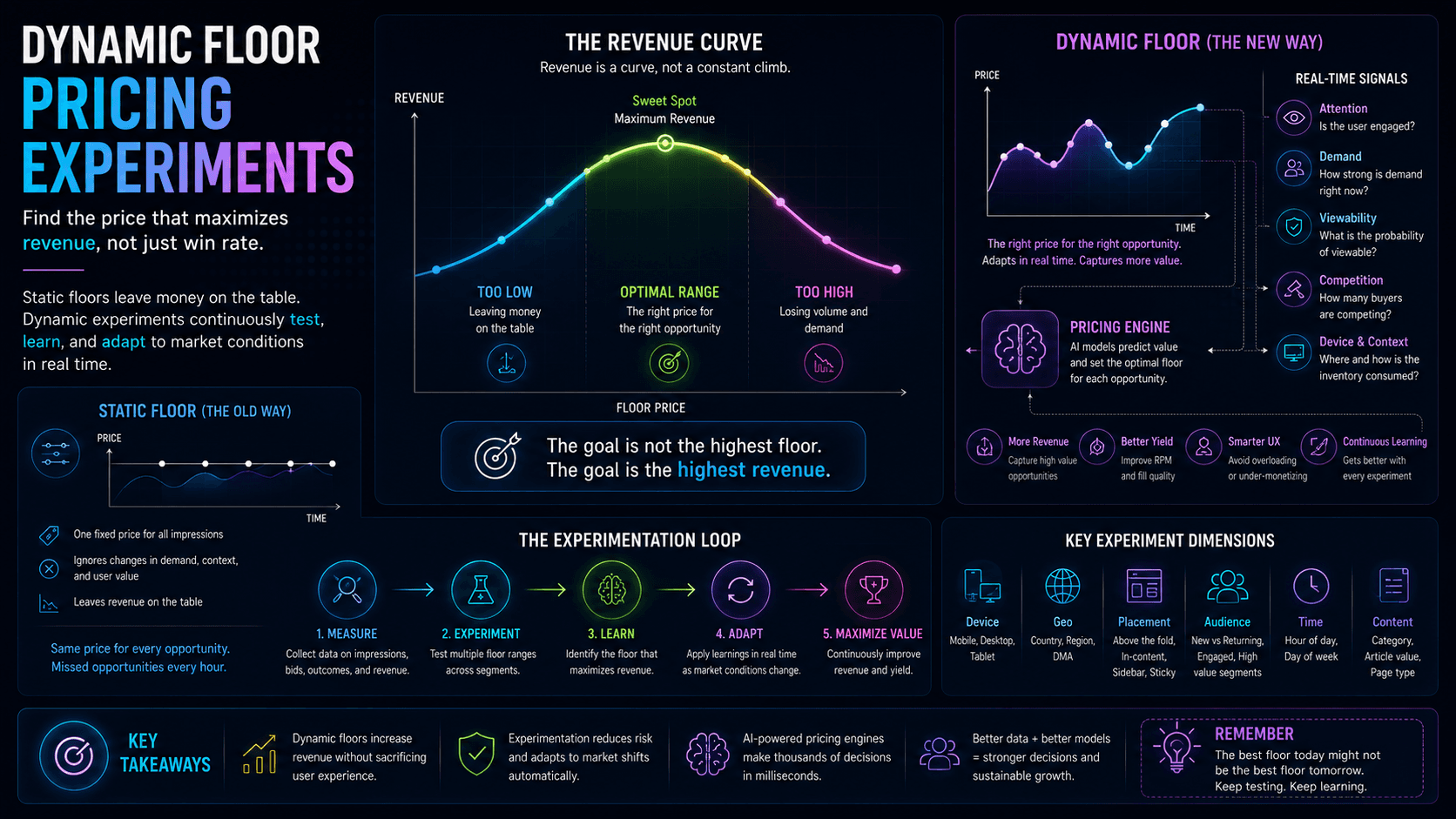
For years, floor pricing has been one of the most influential — and most misunderstood — controls in publisher monetization.
Set the floor too low and valuable inventory may be sold below its true market value. Set the floor too high and demand disappears, reducing fill rate, competition, and ultimately revenue.
The challenge is that there is no universal floor price. Inventory value changes continuously as demand, competition, attention, and user behavior evolve. A floor that maximizes revenue at one moment may become suboptimal minutes later.
Dynamic floor pricing experiments attempt to understand this relationship scientifically. Instead of relying on assumptions, Equalize Labs treats pricing as a measurable system where auctions, user behavior, attention signals, and market conditions can be evaluated together.
Why Static Floors Break Down
Traditional floor strategies often rely on fixed values applied across entire sites, devices, or placements. While simple to manage, static floors assume inventory value remains relatively stable.
Modern programmatic auctions operate in highly dynamic environments. The value of an impression may vary significantly based on:
- User engagement
- Content quality
- Viewability probability
- Attention prediction
- Device characteristics
- Geographic demand
- Time of day
- Bid competition
Two impressions served in the same placement can have dramatically different market values. Static pricing cannot account for this variability, which is why many publishers unknowingly leave revenue on the table.
The Purpose of Dynamic Floor Experiments
The objective is not simply to increase floor prices. The objective is to improve pricing decisions.
Every experiment should begin with a measurable question:
- Does attention justify a higher floor?
- Does strong demand predict higher clearing prices?
- Can viewability probability improve pricing accuracy?
- Should market temperature influence floor selection?
- Does user engagement correlate with optimal floor levels?
Rather than guessing, experiments allow publishers to observe the relationship between signals and outcomes. Over time, pricing becomes evidence-based rather than intuition-based.
Designing a Meaningful Experiment
Every useful experiment starts with a clear hypothesis.
For example:
Impressions with high predicted attention can sustain higher floor prices without reducing competition.
Once the hypothesis is defined, the experiment should establish four core components.
Inputs
Inputs are the signals used to influence floor selection.
Examples include:
- Viewability probability
- Attention score
- Scroll velocity
- Dwell time
- Market temperature
- Demand pressure
- Historical CPM performance
Outputs
Outputs are the metrics used to evaluate success.
Examples include:
- Revenue
- RPM
- Fill rate
- Win rate
- Bid density
- Auction participation
- Average clearing price
Evaluation Window
Experiments require enough observations to reach statistically meaningful conclusions. Depending on traffic volume, this may range from several hours to several weeks.
Success Criteria
Success should be defined before data collection begins.
Examples include:
- Revenue increase without reducing fill rate
- Higher CPM without harming engagement
- Improved yield without increasing latency
Without predefined criteria, experiments often produce ambiguous results and misleading conclusions.
Signals Worth Testing
Modern monetization systems generate hundreds of potential signals. Not all of them deserve equal attention. Several have repeatedly demonstrated strong relationships with inventory value.
Attention State
Users who are actively engaged often create more valuable opportunities than passive visitors. Attention may influence both advertiser performance and bid competition, making it one of the most promising signals for future pricing systems.
Viewability Probability
Predicted visibility provides insight into whether inventory is likely to attract demand. Strong viewability often correlates with stronger auction participation and better advertiser outcomes.
Market Temperature
Periods of elevated competition frequently justify different pricing strategies than periods of weak demand. Understanding market conditions helps publishers align pricing with real opportunities rather than historical averages.
Bid Density
The number of participating bids often reveals whether pricing is aligned with buyer expectations. Strong competition generally indicates additional pricing flexibility.
No-Bid Rate
A rising no-bid rate can indicate that floor prices have become disconnected from market demand. Monitoring this signal helps prevent revenue losses caused by overly aggressive pricing.
Post-Render Engagement
Inventory value does not end at the auction. Post-render behavior helps validate whether pricing decisions align with actual user engagement and advertiser performance.
Understanding Market Temperature
One of the most interesting areas of experimentation involves market temperature. Not all auctions occur under the same demand conditions.
Some environments experience:
- Strong bidder competition
- Aggressive pricing
- Elevated demand pressure
Others experience:
- Sparse participation
- Lower competition
- Conservative bidding
Treating these situations identically often leaves revenue on the table. Dynamic floor experiments help identify when pricing should adapt to changing market conditions rather than relying on static assumptions.
Interpreting Results Correctly
One of the most common mistakes in monetization research is focusing on a single metric.
A floor increase may produce higher CPMs while simultaneously reducing fill rate. At first glance, the CPM increase appears successful. However, total revenue may decline.
Similarly, a lower floor may increase fill rate while reducing average impression value.
The strongest evaluations consider multiple dimensions simultaneously:
- Revenue
- RPM
- CPM
- Fill rate
- Viewability
- Attention
- User experience
- Latency
Revenue growth that damages long-term inventory quality is rarely sustainable.
Turning Experiments Into Intelligence
Experiments become truly valuable when their findings move beyond reporting.
Measured patterns can evolve into:
Production Rules
Simple decision logic based on proven outcomes.
Pricing Models
Predictive systems capable of estimating optimal floors before the auction begins.
Model Features
Signals incorporated into machine learning systems.
Decision Systems
Automated frameworks capable of adapting monetization strategy in real time.
This is where experimentation becomes a competitive advantage. Knowledge compounds, and every successful experiment increases the quality of future decisions.
From Experiments to Predictive Pricing
The long-term goal is not endless testing. The goal is understanding.
As experiments accumulate, publishers can begin building predictive systems that answer questions such as:
- What floor maximizes expected revenue?
- Which inventory deserves protection?
- When should pricing become more aggressive?
- When should floors become more conservative?
The transition from experimentation to prediction represents the next evolution of publisher monetization.
Conclusion
Dynamic floor pricing is not simply a yield optimization tactic. It is a framework for understanding inventory value.
By measuring attention, demand, competition, market conditions, and auction outcomes together, publishers gain a clearer view of how pricing decisions influence revenue. Every successful experiment creates reusable intelligence, and every piece of intelligence improves future decisions.
The purpose of Equalize Labs is not merely to test ideas. It is to transform monetization from intuition into a measurable, repeatable, and increasingly predictive system.