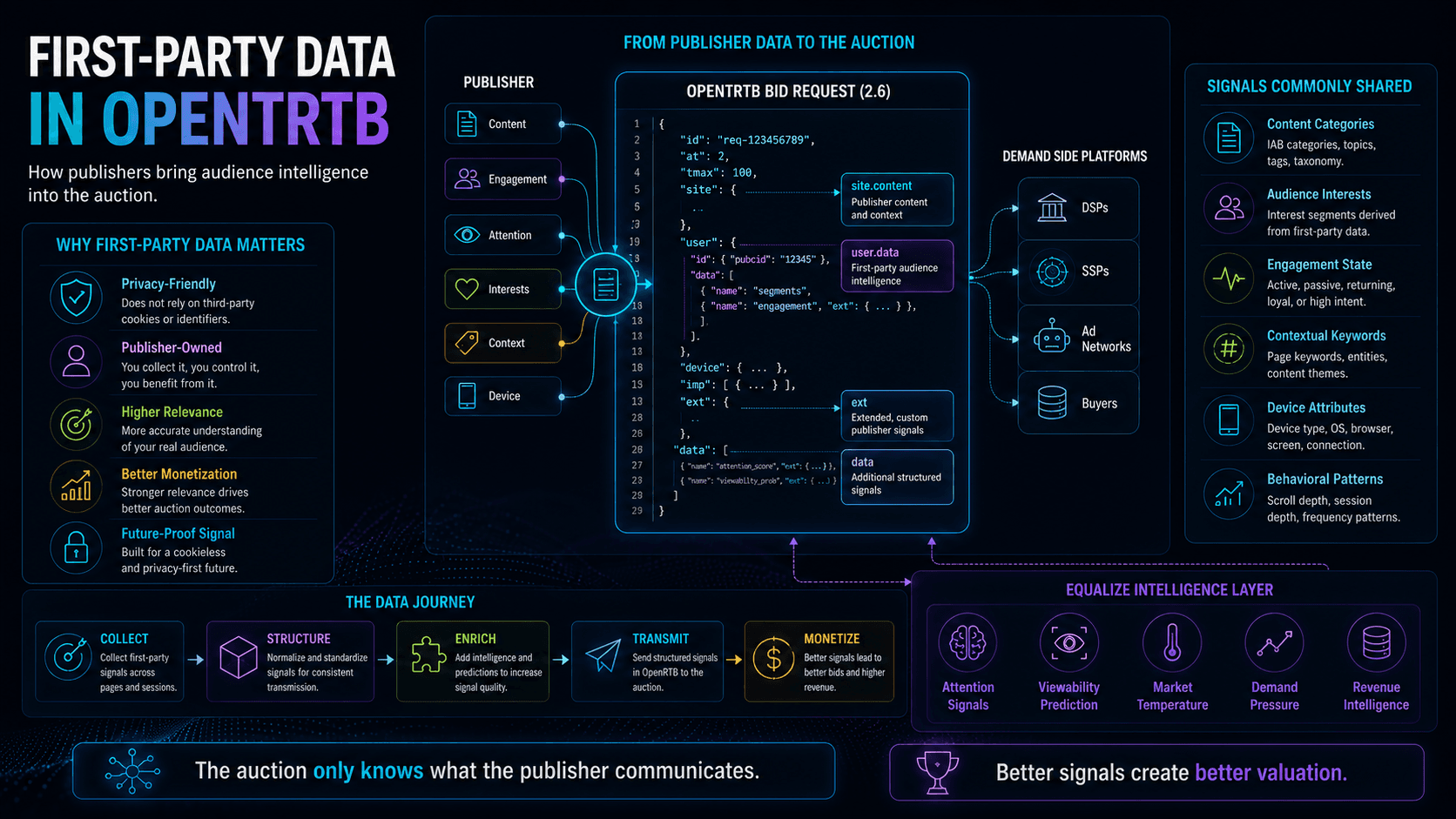
The advertising industry is entering a new era of publisher-owned intelligence.
For years, much of digital advertising relied on third-party cookies, external identifiers, and buyer-side data platforms to understand audiences. As privacy regulations evolved and browser restrictions increased, publishers began reassessing one of their most valuable assets: the data they collect directly from their own audiences.
This shift has transformed first-party data from a supporting signal into a strategic advantage.
Today, some of the most valuable information in a programmatic auction originates with the publisher itself. Content consumption patterns, engagement signals, contextual information, audience interests, and behavioral observations can all help buyers better understand inventory quality.
The challenge is not collecting this information.
The challenge is communicating it effectively to the market.
This is where OpenRTB becomes critical.
Why First-Party Data Matters
Every publisher possesses information that advertisers cannot easily access elsewhere.
Unlike third-party datasets, first-party signals originate from direct interactions between users and content. These signals are often more accurate, more relevant, and more reflective of actual audience behavior.
Examples include:
- Content interests
- Reading behavior
- Engagement patterns
- Session depth
- Content categories
- Audience segments
- Device characteristics
Because publishers own these relationships, they control how data is collected, structured, and activated.
This creates a significant competitive advantage in a privacy-first advertising ecosystem.
The Shift Toward Publisher Intelligence
Historically, much of the industry's intelligence existed on the buy side.
DSPs built models.
Advertisers built audiences.
Data providers supplied targeting signals.
Publishers primarily supplied inventory.
That balance is changing.
As audience identifiers become less reliable and contextual intelligence becomes more important, publishers are increasingly responsible for communicating inventory quality directly through the auction itself.
The result is a growing emphasis on publisher-owned signals and sell-side intelligence.
How OpenRTB Supports First-Party Data
OpenRTB provides standardized structures that allow publishers to communicate information about users, content, devices, and inventory opportunities.
While implementations vary across platforms, several areas commonly carry first-party intelligence.
Site Content
The site object helps describe the environment where an impression appears.
Publishers can communicate:
- Content categories
- Keywords
- Topics
- Contextual information
- Content quality indicators
These signals help buyers understand the content surrounding an impression and evaluate contextual relevance.
User Data
The user object provides a framework for audience-related information.
Publishers may communicate:
- Audience segments
- Interest categories
- Behavioral classifications
- Engagement states
- Custom attributes
The objective is not to identify individuals.
The objective is to help buyers understand audience characteristics in privacy-safe ways.
Device Signals
Device information provides additional context about the environment where inventory is consumed.
Examples include:
- Device type
- Screen dimensions
- Operating system
- Browser environment
- Connectivity characteristics
These signals influence both valuation and campaign suitability.
Extensions and Custom Signals
Many publishers also enrich OpenRTB requests using extension fields.
These areas often carry advanced monetization signals such as:
- Attention measurements
- Viewability predictions
- Inventory quality scores
- Market intelligence
- Revenue optimization signals
This allows publishers to communicate information that extends beyond traditional auction metadata.
The Difference Between Data and Intelligence
Collecting data is not the same as creating intelligence.
Many publishers transmit large amounts of information through OpenRTB while adding relatively little value.
The most effective first-party strategies focus on transforming raw observations into useful signals.
For example:
Raw Data:
- Scroll depth
- Time on page
- Page category
Intelligence:
- Engagement state
- Attention probability
- Content affinity
- Session quality
Buyers benefit more from meaningful interpretation than from large volumes of disconnected data points.
The goal is not to send more information.
The goal is to send better information.
What Buyers Actually Value
Not every signal improves auction outcomes.
The most valuable signals tend to help buyers answer practical questions such as:
- Is this user engaged?
- Is this inventory likely to be viewed?
- Is the content relevant?
- Is the environment trustworthy?
- Is this opportunity likely to perform?
Signals that improve decision-making often create stronger competition and better valuation.
This is why first-party data is increasingly becoming a revenue strategy rather than simply a targeting strategy.
Privacy and the Future of Signal Sharing
One reason first-party data has become so important is its compatibility with privacy-first advertising models.
Modern advertising systems increasingly prioritize:
- Transparency
- Consent
- Data minimization
- Publisher control
Unlike third-party tracking ecosystems, first-party signals originate within trusted publisher relationships.
This makes them more sustainable as privacy regulations continue evolving.
Publishers that invest in high-quality first-party data strategies today are building foundations for future monetization systems.
Beyond Segments: The Next Generation of Signals
The future of first-party data extends beyond traditional audience segmentation.
Modern publisher intelligence increasingly includes:
- Attention signals
- Viewability prediction
- Content quality indicators
- Engagement scoring
- Demand forecasting
- Market temperature analysis
These signals help describe not only who the audience is, but also the quality and value of the opportunity itself.
This represents an important evolution in programmatic advertising.
The conversation is shifting from audience targeting toward inventory understanding.
First-Party Data as a Revenue Asset
Many publishers still view first-party data primarily as a product for advertisers.
Increasingly, it should be viewed as a monetization asset.
Better signals can improve:
- Inventory valuation
- Auction competition
- Demand quality
- Pricing decisions
- Revenue efficiency
The value comes not from collecting data, but from using it to improve how inventory is understood by the market.
Publishers that communicate inventory quality effectively often create stronger competition without creating additional inventory.
Conclusion
First-party data has become one of the most important assets available to publishers.
As the advertising ecosystem moves toward privacy-first architectures, publisher-owned intelligence is becoming increasingly valuable in programmatic auctions.
OpenRTB provides the framework for communicating that intelligence to buyers, but the greatest opportunity lies in transforming raw observations into meaningful signals.
The future belongs to publishers that understand not only their audiences, but also how to communicate inventory value through the auction itself.
Because better signals create better valuation.
And better valuation creates better monetization.