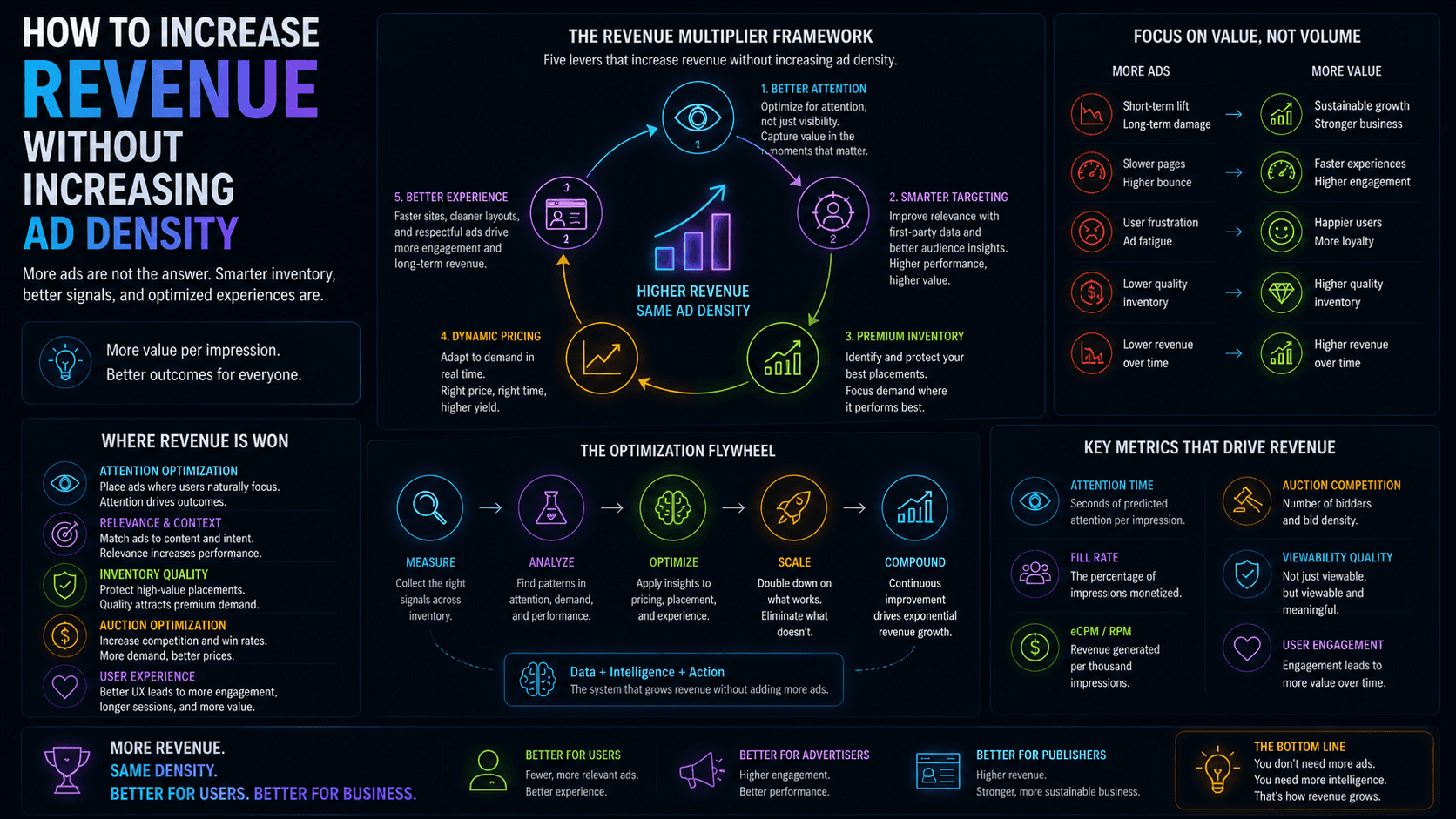
One of the most common assumptions in digital publishing is that revenue growth requires more inventory.
More placements.
More refreshes.
More advertising opportunities.
For years, the industry treated impression volume as the primary path to monetization growth. If revenue slowed, the solution was often to create more inventory. Add another placement. Increase refresh frequency. Expand available opportunities.
While this approach can sometimes generate short-term gains, it often creates unintended consequences. Additional inventory competes for the same user attention, increases clutter, and can reduce the value of existing placements.
The good news is that revenue growth does not always require more ads.
Many of the most successful publishers increase monetization by improving the quality of their inventory rather than expanding its quantity.
The goal is not to create more opportunities.
The goal is to create better opportunities.
Why More Inventory Is Not Always Better
Every page has a limited amount of user attention.
When additional placements are introduced, those placements compete for the same attention pool. As inventory expands, attention becomes fragmented and the performance of individual impressions often declines.
Common side effects include:
- Reduced engagement
- Lower advertiser performance
- Increased banner blindness
- More visual clutter
- Weaker user experience
Eventually, the value of each impression begins to fall.
This creates a situation where more inventory generates less value. Revenue growth becomes increasingly difficult despite growing impression volume.
The problem is not inventory supply.
The problem is inventory quality.
The Shift From Volume to Value
Successful publishers increasingly think about monetization differently.
Instead of asking:
How many impressions can we create?
They ask:
How can we increase the value of every impression?
This shift changes the entire optimization strategy.
Inventory quality becomes more important than inventory volume. Advertisers compete more aggressively for inventory that consistently performs, attracts attention, and delivers outcomes.
As competition increases, CPMs and overall revenue often improve naturally.
The focus moves from creating more inventory to creating more valuable inventory.
Optimize Placement Quality
Placement quality has a direct impact on auction performance.
Two placements with identical demand partners can generate dramatically different outcomes depending on where they appear and how users interact with them.
High-performing placements often benefit from:
- Strong visibility
- Natural content integration
- Higher attention levels
- Better engagement opportunities
- Strong reading flow
Premium placements are rarely accidental. They tend to appear where attention, context, and user experience align.
Improving placement quality often increases revenue without increasing the number of placements on the page.
Increase Attention, Not Inventory
Attention is one of the most valuable resources in digital advertising.
Advertisers are ultimately buying the opportunity to influence behavior. An impression that receives meaningful attention is usually worth more than several impressions that are quickly ignored.
Research across the advertising industry increasingly shows that attention often correlates more closely with outcomes than simple visibility metrics.
Strategies that improve attention include:
- Cleaner layouts
- Better content flow
- Reduced clutter
- Contextually relevant placements
- Stronger engagement experiences
The result is higher-value inventory rather than simply larger inventory.
Improve Viewability the Right Way
Viewability remains one of the strongest signals in programmatic advertising.
Inventory that is consistently visible tends to attract stronger demand and higher auction competition. However, viewability should support user experience rather than fight against it.
Publishers can improve viewability by:
- Positioning ads naturally within content
- Reducing layout shifts
- Improving page speed
- Loading inventory at the right moment
- Protecting premium placements
Higher viewability often increases CPMs without requiring additional inventory.
The key is improving meaningful visibility rather than artificially maximizing viewability metrics.
Use Smarter Refresh Strategies
Refresh can create additional monetization opportunities.
However, fixed-timer refresh strategies often generate unnecessary inventory and dilute impression quality.
Adaptive refresh focuses on quality rather than quantity.
Refreshes occur when:
- The user is actively engaged
- The placement remains visible
- Attention remains strong
- Demand conditions are favorable
This creates fewer but more valuable auctions.
Instead of maximizing impression count, publishers maximize impression quality.
Strengthen Auction Competition
Revenue growth is not only a function of inventory quality.
It is also influenced by demand quality.
Publishers can improve auction competition by:
- Expanding demand partnerships
- Optimizing header bidding configurations
- Improving auction efficiency
- Strengthening first-party data signals
- Reducing supply path friction
When more qualified buyers compete for the same inventory, pricing improves naturally.
Often the fastest revenue gains come from improving competition rather than increasing inventory.
Improve Content Quality
Great content creates better monetization opportunities.
Publishers sometimes focus exclusively on advertising optimization while overlooking the experience that creates inventory value in the first place.
High-quality content often leads to:
- Longer sessions
- Stronger engagement
- Higher attention
- Better advertiser performance
- More valuable audiences
Content quality remains one of the most powerful revenue drivers available to publishers.
The best inventory is usually created by the best user experiences.
Remove What Is Not Creating Value
One of the most counterintuitive optimization strategies is removing inventory.
Low-performing placements often consume attention without contributing meaningful revenue.
Reducing clutter can improve:
- Attention
- Viewability
- Engagement
- Auction competition
- Overall inventory quality
The remaining placements become more valuable because they receive a larger share of available attention.
In many cases, fewer placements produce stronger outcomes.
Build a Value-Creation System
The strongest monetization strategies treat revenue as the output of a larger system.
That system includes:
- User experience
- Content quality
- Attention
- Viewability
- Demand competition
- Placement quality
- Auction efficiency
Improving these components increases inventory value.
Increasing inventory value increases revenue.
The focus shifts from creating more impressions to creating better impressions.
This is the foundation of sustainable monetization.
Conclusion
Publishers do not always need more ads to increase revenue.
In many cases, the greatest opportunities come from improving the quality of existing inventory.
Better placements.
Better attention.
Better viewability.
Better competition.
Better user experiences.
When inventory becomes more valuable, advertisers compete harder for it. And when advertisers compete harder, revenue grows naturally.
The future of yield optimization is not about maximizing inventory.
It is about maximizing value.