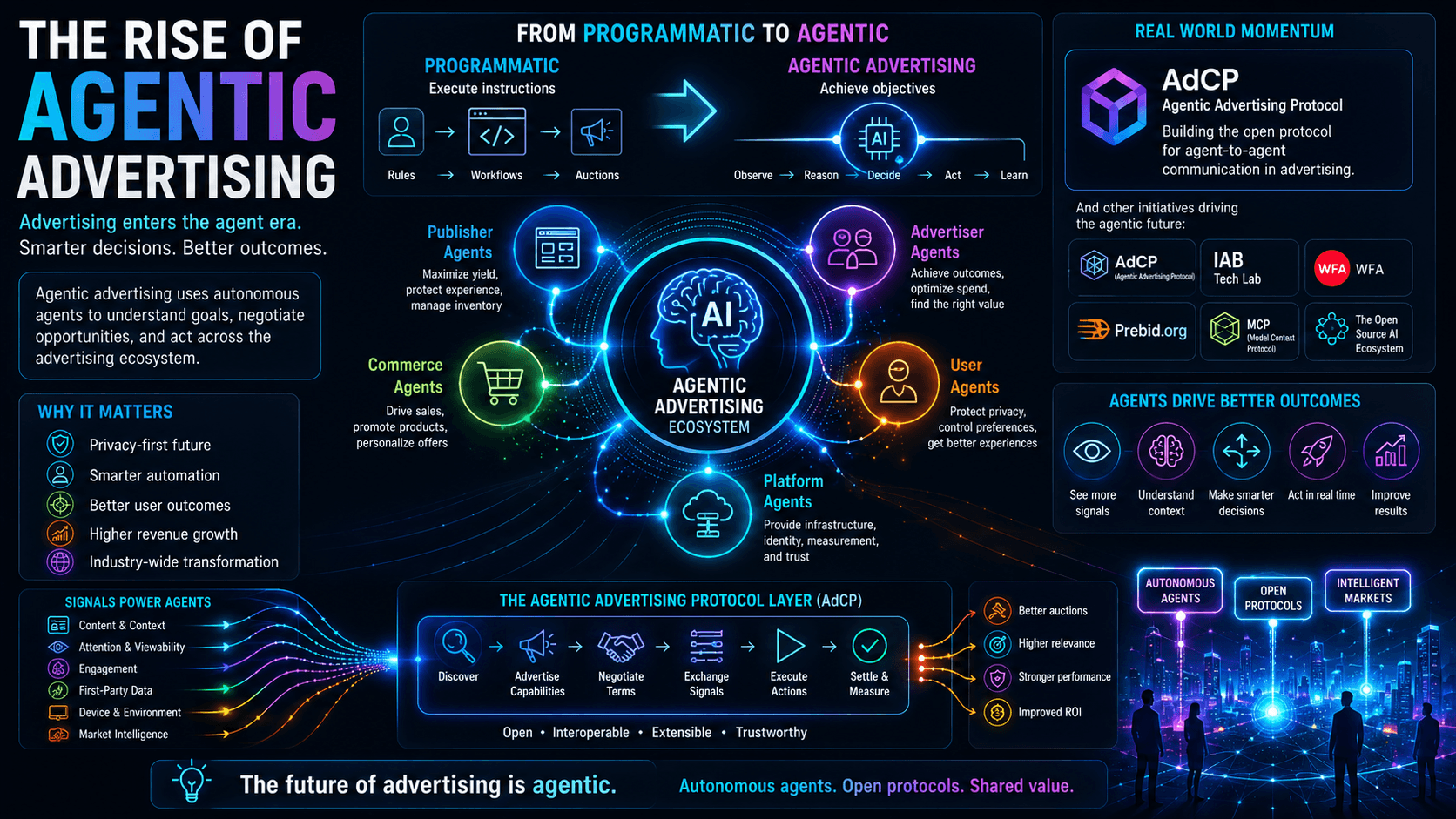
For more than two decades, digital advertising has been built around a relatively simple model.
Publishers create inventory.
Advertisers buy inventory.
Platforms facilitate the transaction.
The process became increasingly automated through programmatic advertising, real-time bidding, and machine learning. Yet despite these advances, most participants in the ecosystem still operate through predefined rules, fixed workflows, and limited decision-making capabilities.
A new model is beginning to emerge.
Instead of software executing static instructions, intelligent agents are starting to make decisions, negotiate outcomes, evaluate opportunities, and act on behalf of users, publishers, advertisers, and platforms.
This shift is commonly described as Agentic Advertising.
And unlike many future-looking concepts, it is already happening.
From Automation to Agency
Programmatic advertising automated transactions.
Agentic advertising automates decision-making.
The difference is significant.
Traditional advertising systems execute workflows that humans define in advance:
- Target this audience
- Apply this budget
- Use this bidding strategy
- Follow these campaign rules
Agentic systems operate differently.
They receive objectives rather than instructions.
An agent may be asked to:
- Maximize campaign outcomes
- Protect user experience
- Increase publisher revenue
- Improve inventory quality
- Find the best commercial opportunity
The agent then evaluates available information and determines how to achieve those goals.
The system becomes adaptive rather than procedural.
Why Agentic Systems Are Emerging Now
Several industry shifts are accelerating the transition toward agent-based advertising.
Artificial Intelligence Maturity
Modern AI systems can reason across increasingly complex environments.
They can evaluate multiple objectives simultaneously, process large volumes of signals, and adapt strategies as conditions change.
This makes them suitable for real-time decision environments such as advertising auctions and media marketplaces.
The Complexity Problem
Modern advertising generates more signals than humans can realistically manage.
Examples include:
- Attention signals
- Contextual information
- Privacy requirements
- Auction dynamics
- Identity frameworks
- Supply path decisions
- Market conditions
As complexity increases, intelligent agents become increasingly valuable.
The Shift Toward Decision Systems
Across the industry, measurement systems are evolving into decision systems.
Instead of simply reporting what happened, platforms increasingly determine what should happen next.
Agentic advertising is a natural extension of this evolution.
What Makes Advertising Agentic?
An advertising system becomes agentic when it can:
Observe
Understand signals from its environment.
Reason
Evaluate objectives and tradeoffs.
Decide
Choose between multiple possible actions.
Act
Execute decisions autonomously.
Learn
Improve future decisions using outcomes.
This framework already appears in many modern AI systems.
The difference is that advertising is beginning to adopt it as infrastructure rather than experimentation.
The Emergence of AdCP
One of the most important developments in this space is the emergence of the Agentic Advertising Protocol, commonly known as AdCP.
AdCP is helping establish standards for how advertising agents discover opportunities, communicate capabilities, negotiate commercial relationships, and exchange information across platforms.
Much like OpenRTB standardized programmatic auctions, agentic protocols aim to standardize interactions between autonomous participants in advertising ecosystems.
The significance of this effort should not be underestimated.
Standards often become the foundation upon which entirely new markets are built.
The organizations and contributors working on AdCP are helping define how future advertising systems may communicate and cooperate.
Beyond Buying and Selling
One of the most interesting aspects of agentic advertising is that it extends beyond traditional media buying.
Agents can potentially represent:
- Publishers
- Advertisers
- Consumers
- Retailers
- Creators
- Commerce platforms
A publisher agent might negotiate pricing.
An advertiser agent might optimize outcomes.
A consumer agent might manage privacy preferences and commercial interests.
The marketplace becomes a network of interacting decision systems rather than a collection of isolated software products.
Publishers Gain New Leverage
Historically, much of advertising intelligence has lived on the buy side.
DSPs invested heavily in prediction, optimization, and automation.
Publishers often relied on comparatively static monetization systems.
Agentic advertising changes this dynamic.
Publishers can now build agents capable of:
- Valuing inventory
- Predicting outcomes
- Managing floors
- Optimizing placements
- Negotiating commercial opportunities
- Protecting user experience
This creates a new layer of sell-side intelligence.
Rather than simply exposing inventory to demand, publishers can actively participate in value creation.
The Connection to Sell-Side Decisioning
Many of the concepts emerging within agentic advertising are closely related to sell-side decisioning.
For example:
- Predictive pricing
- Attention optimization
- Dynamic routing
- Demand forecasting
- Inventory valuation
These systems already perform many agent-like functions.
As capabilities expand, the line between decision systems and agents becomes increasingly blurred.
In many ways, sell-side intelligence represents one of the earliest forms of agentic infrastructure within publishing.
Challenges Ahead
Like any major transition, agentic advertising introduces new challenges.
Questions remain around:
- Transparency
- Accountability
- Privacy
- Trust
- Governance
- Interoperability
Industry standards will play a critical role in ensuring agents can operate responsibly and consistently.
This is one reason initiatives such as AdCP are attracting significant attention across the ecosystem.
The future will require not only intelligent agents, but trusted frameworks for how those agents interact.
The Industry Is Already Moving
Agentic advertising is often described as a future trend.
The reality is that many of its foundations already exist.
Across the industry, organizations are building:
- AI-powered optimization systems
- Autonomous bidding strategies
- Predictive monetization engines
- Attention-based valuation models
- Intelligent commerce agents
- Agent communication frameworks
The terminology may still be evolving.
The underlying transformation is already underway.
Conclusion
The advertising industry is moving beyond automation and toward agency.
The next generation of systems will not simply execute instructions. They will evaluate opportunities, negotiate outcomes, optimize decisions, and act on behalf of the organizations they represent.
Initiatives such as AdCP are helping establish the standards that make these interactions possible, while publishers, advertisers, and technology companies increasingly experiment with autonomous decision systems.
The transition from programmatic advertising to agentic advertising will not happen overnight.
But it has already begun.
And like many of the most important changes in digital advertising, it is likely to become obvious only after it has already transformed the market.