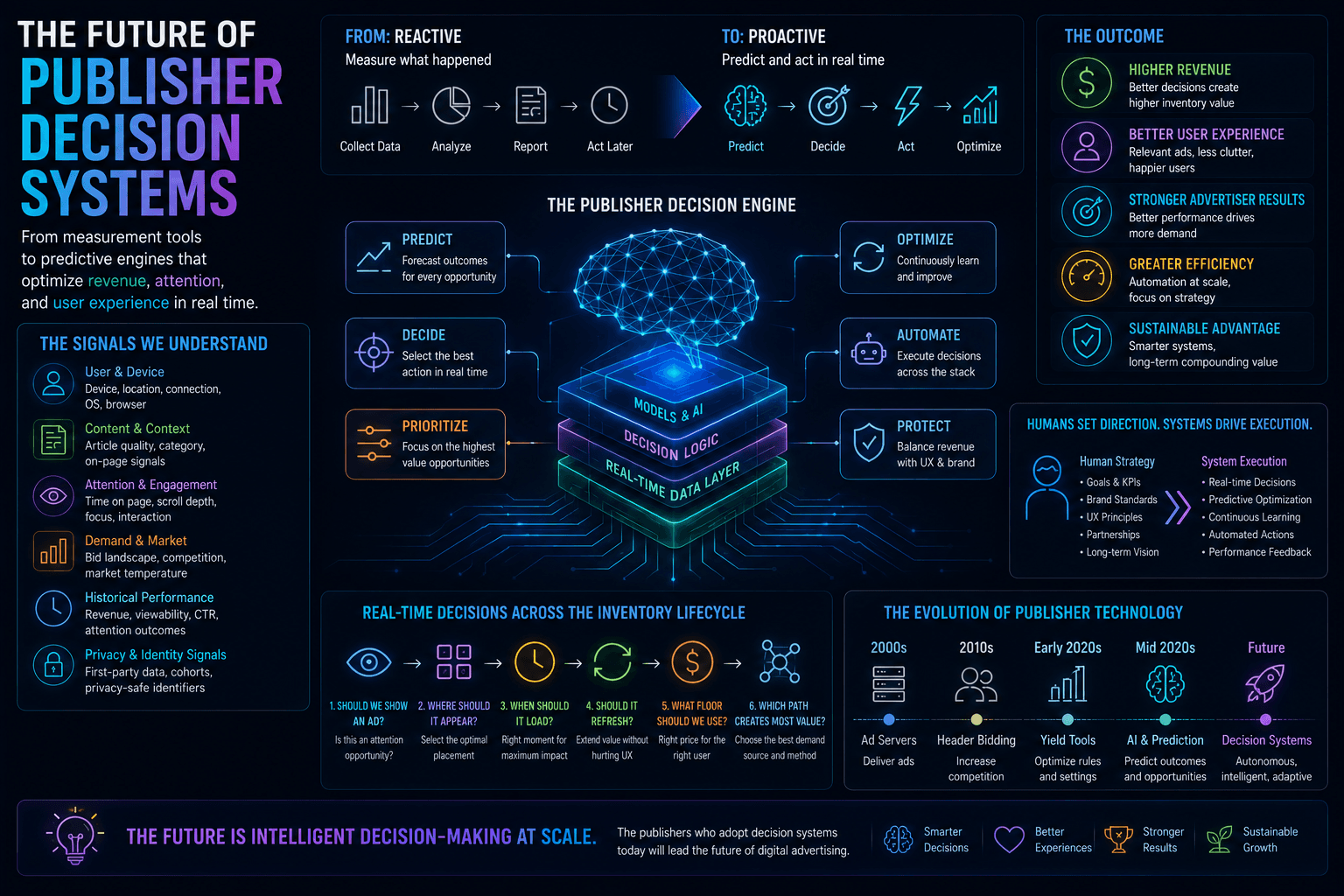
For most of the history of digital advertising, publisher technology has been reactive.
Analytics platforms measured what happened.
Ad servers delivered campaigns.
Header bidding increased competition.
Reporting systems explained results after the fact.
The industry became exceptionally good at collecting information.
It became far less effective at acting on it.
That is beginning to change.
A new generation of publisher technology is emerging—one built not around reporting, but around decision-making.
These systems do not simply measure performance.
They continuously evaluate opportunities, predict outcomes, and optimize revenue in real time.
The future of publisher monetization belongs to decision systems.
From Measurement to Action
Most publisher stacks today are composed of specialized tools.
Examples include:
- Analytics platforms
- Ad servers
- Header bidding wrappers
- Viewability measurement tools
- Audience platforms
- Yield management systems
Each component produces valuable data.
The challenge is that none of them make holistic decisions.
Human operators remain responsible for:
- Placement strategy
- Floor optimization
- Refresh rules
- Demand routing
- Inventory prioritization
As inventory becomes more complex, this model becomes increasingly difficult to scale.
The number of variables simply exceeds what manual decision-making can manage efficiently.
The Rise of Real-Time Decisioning
Modern monetization environments generate thousands of signals.
Examples include:
- Attention levels
- Viewability probability
- Content quality
- User engagement
- Device characteristics
- Demand competition
- Historical performance
- Market conditions
Traditional systems measure these signals.
Decision systems act on them.
Rather than applying static rules, decision systems continuously ask:
- Should this impression be created?
- Where should it appear?
- When should it load?
- Should it refresh?
- What floor price should be applied?
- Which demand path creates the highest value?
Every decision becomes dynamic.
Why Static Rules Are Breaking Down
Many monetization strategies still rely on fixed configurations.
Examples include:
- Refresh every 30 seconds
- Fixed floor prices
- Universal placement rules
- Identical auction settings for all users
These approaches were effective when the ecosystem was simpler.
Today's environment is different.
The value of an impression changes constantly.
A placement may be worth significantly more:
- For one user than another
- On one device than another
- In one content context than another
- At one moment than another
Static rules cannot capture this complexity.
Decision systems can.
The Evolution of Sell-Side Intelligence
Historically, most advertising intelligence lived on the buy side.
DSPs evaluated inventory.
Advertisers optimized campaigns.
Publishers focused primarily on supply.
That balance is shifting.
Publishers now have access to:
- Rich behavioral signals
- First-party data
- Attention metrics
- Content intelligence
- Auction performance history
This creates an opportunity for the sell side to become more intelligent.
Instead of simply exposing inventory to demand, publishers can actively shape monetization outcomes.
This evolution is often described as sell-side decisioning.
Predictive Systems Replace Reactive Systems
One of the most significant changes is the shift from measurement to prediction.
Traditional systems answer:
"What happened?"
Decision systems increasingly answer:
"What is likely to happen next?"
Predictive capabilities include:
- Viewability forecasting
- Attention prediction
- Demand forecasting
- Revenue projection
- Auction outcome prediction
This allows optimization to occur before value is lost.
The system can identify opportunities before they become obvious.
Attention Becomes a Core Signal
Future decision systems will increasingly optimize around attention rather than visibility alone.
Visibility answers:
"Can the user see the ad?"
Attention answers:
"Is the user likely to care?"
This distinction matters.
Advertisers ultimately pay for outcomes.
Outcomes are driven by attention.
As attention measurement improves, decision systems gain a stronger understanding of inventory value.
Revenue Becomes a Dynamic Outcome
Traditionally, publishers treated revenue as the result of inventory volume.
More impressions created more opportunities.
Decision systems introduce a different model.
Revenue becomes the result of:
- Better timing
- Better placement selection
- Better demand routing
- Better attention opportunities
- Better user experiences
The focus shifts from inventory creation to value creation.
This is a fundamentally different philosophy.
Human Strategy, Machine Execution
The future does not eliminate human decision-making.
It changes where humans provide value.
Teams will spend less time managing tactical settings.
They will spend more time defining objectives.
Examples include:
- Revenue targets
- User experience standards
- Attention goals
- Inventory strategies
- Demand relationships
Decision systems handle execution.
Humans define direction.
This creates a more scalable operating model.
The Publisher Operating System
Over time, individual optimization tools are likely to converge.
Instead of separate systems managing:
- Floors
- Refresh
- Viewability
- Attention
- Auctions
Publishers will increasingly rely on unified decision layers.
These systems function as operating systems for monetization.
They evaluate signals continuously and coordinate decisions across the entire inventory ecosystem.
The result is greater efficiency and more consistent optimization.
A Competitive Advantage for Publishers
The publishers that adopt decision systems earliest will likely gain significant advantages.
Benefits may include:
- Higher inventory value
- Better advertiser performance
- Stronger user experiences
- Faster optimization cycles
- Greater operational efficiency
The advantage comes from making better decisions, not simply collecting more data.
Data alone is no longer enough.
Intelligence comes from action.
Conclusion
Publisher technology is entering a new phase.
The industry is moving beyond measurement and toward decision-making.
Future systems will continuously evaluate signals, predict outcomes, and optimize monetization in real time.
The most successful publishers will not be those with the most data.
They will be the ones with the best decision systems.
Because the future of monetization is not about knowing more.
It is about deciding better.