Every publisher has them.
Placements that consistently outperform expectations. They generate stronger CPMs, attract more competition, achieve higher engagement, and deliver better outcomes for advertisers. Over time, they become the inventory buyers actively seek out and repeatedly value.
These opportunities are often described as premium placements.
The common misconception is that premium inventory is created through intuition, experience, or simply occupying a desirable location on the page. In reality, premium placements tend to follow recognizable patterns. They are not random. They emerge when attention, context, visibility, and user behavior align in ways that create measurable value.
Understanding these patterns is one of the most effective ways to improve monetization without increasing ad density.
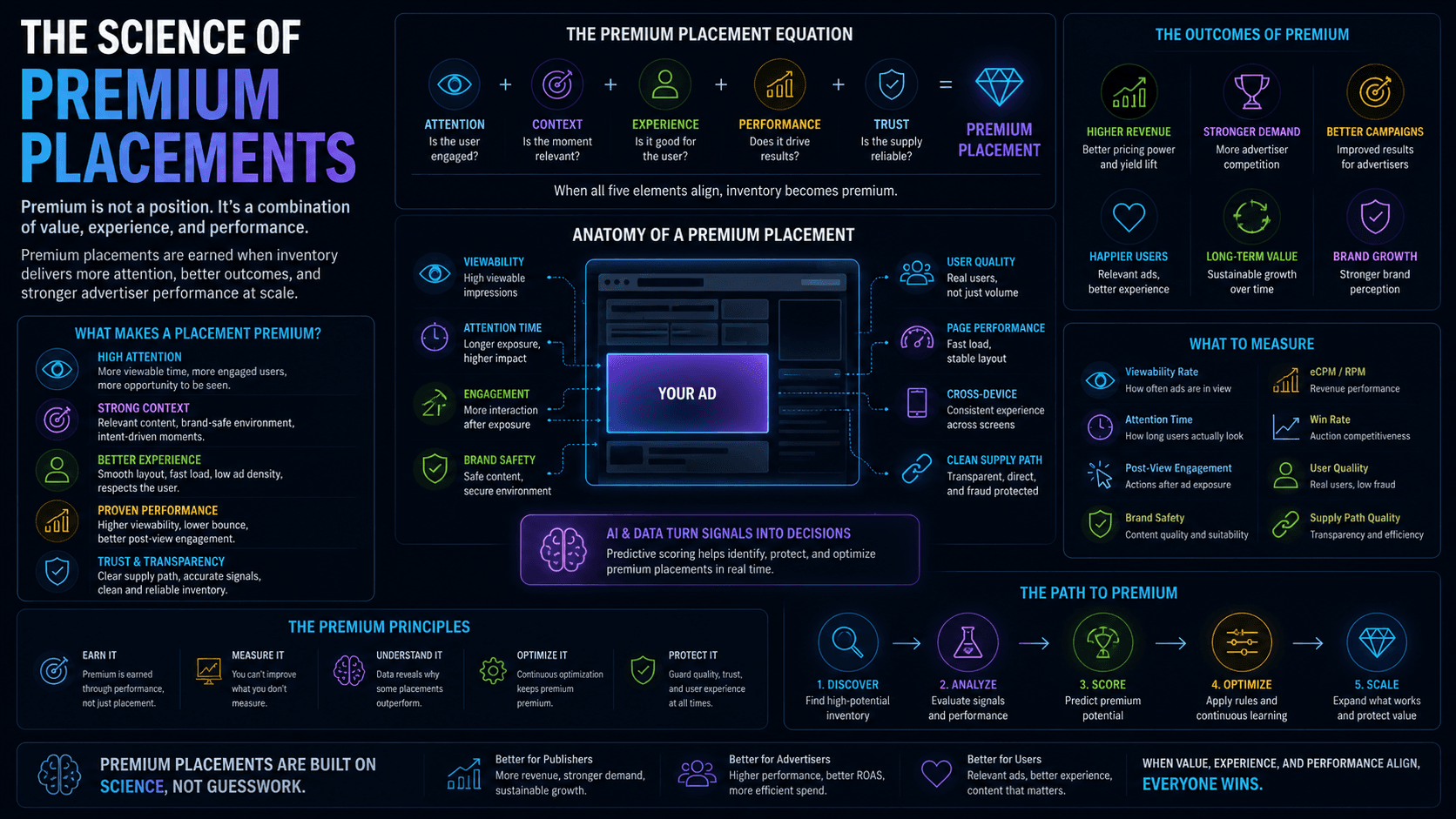
What Makes a Placement Premium?
A premium placement is not simply an ad located at the top of a page.
Premium inventory creates stronger outcomes because it captures valuable user attention at the right moment. Advertisers care less about where an ad appears and more about whether it influences outcomes.
Several characteristics consistently appear in high-performing placements:
- Strong viewability
- High attention levels
- Natural content integration
- Longer in-view time
- Better engagement rates
- Strong advertiser performance
- Consistent auction competition
These signals create a feedback loop. Better performance attracts stronger demand, stronger demand increases competition, and increased competition improves pricing.
Premium placements become premium because the market repeatedly validates their value.
Attention Is the Foundation
The most valuable placements usually occupy moments where user attention is naturally concentrated.
Users do not consume content evenly. Some sections of a page receive dramatically more attention than others. Research from attention measurement companies such as Adelaide, Lumen, and Amplified Intelligence has consistently shown that visibility alone does not explain advertising effectiveness.
Attention is often concentrated around:
- The beginning of an article
- Key transition points
- High-interest content sections
- Interactive moments
- Areas with strong reading flow
When advertising aligns with these attention peaks, performance improves. Premium placements often emerge where users are most engaged with content rather than where publishers simply place ads.
This is why attention is increasingly becoming one of the most important signals in modern monetization systems.
Viewability Is Necessary But Not Sufficient
Viewability remains one of the most important metrics in digital advertising.
Inventory that cannot be seen rarely performs well. However, visibility alone does not create value. A viewable placement can still be ignored, skipped, or forgotten.
A placement becomes premium when visibility combines with meaningful attention.
This distinction explains why two placements with identical viewability scores can produce dramatically different results. One may simply enter the viewport, while the other captures genuine user focus.
Advertisers ultimately pay for outcomes, not pixels.
Viewability creates the opportunity. Attention determines whether the opportunity matters.
Reading Flow Matters
Users move through content in predictable ways.
They read. Pause. Scan. Interact. Continue.
Premium placements often align with these natural behaviors rather than interrupting them. The strongest placements feel integrated into the experience rather than competing against it.
Common examples include:
- Between meaningful content sections
- Following completed thoughts
- Near moments of high engagement
- Around interactive content experiences
When placements align with reading flow, users are more receptive and advertisers receive better outcomes.
This benefits both monetization performance and user experience.
Context Influences Value
The surrounding environment plays a significant role in inventory quality.
Advertisers increasingly evaluate not only who sees an impression, but also where it appears and what surrounds it. Contextual relevance has become even more important as privacy changes reduce the availability of traditional targeting methods.
Strong contextual alignment often improves:
- Engagement
- Brand recall
- Campaign effectiveness
- Bid competition
- Conversion performance
Premium inventory is rarely defined by position alone. Content quality, audience intent, and contextual relevance frequently influence value just as much as placement location.
Demand Follows Performance
Premium placements are not created by labels. They are created by results.
Advertisers continuously evaluate outcomes. When a placement consistently performs well, demand naturally increases. Higher-performing inventory often attracts:
- More bidders
- More aggressive bids
- Higher CPMs
- Better campaign budgets
- Stronger long-term demand
Over time, the market begins to recognize which opportunities create value.
Performance attracts competition.
Competition increases value.
Value reinforces premium status.
This cycle explains why some placements consistently outperform others despite appearing similar on the surface.
Identifying Premium Opportunities
Publishers can identify premium placements by studying performance signals rather than relying on assumptions.
Important indicators include:
- Viewability rate
- Attention metrics
- In-view time
- Scroll behavior
- Engagement rate
- Auction competition
- Historical CPM performance
- Demand pressure
Patterns often emerge quickly. The strongest placements tend to outperform repeatedly rather than occasionally.
The goal is not simply to identify yesterday's winners. The goal is to understand why they perform.
Premium Placements Are Dynamic
One of the most common misconceptions is that premium inventory never changes.
User behavior evolves.
Content formats evolve.
Demand conditions evolve.
A premium placement today may not remain premium forever.
This is why modern optimization increasingly relies on continuous measurement rather than fixed assumptions. The most advanced publishers treat premium inventory as a discovery process rather than a permanent designation.
New opportunities emerge constantly.
The challenge is recognizing them before competitors do.
A Scientific Approach to Monetization
The most advanced publishers treat placement optimization as an ongoing research process.
They test.
They measure.
They compare.
They learn.
Rather than relying solely on intuition, they use behavioral, contextual, and performance signals to identify inventory value.
This transforms monetization from guesswork into a repeatable system.
Premium placements become measurable outcomes rather than subjective opinions.
Over time, this approach creates a competitive advantage because publishers gain a deeper understanding of what drives inventory value across their properties.
Conclusion
Premium placements are not accidental.
They emerge where attention, visibility, engagement, context, and demand intersect. Publishers that understand these signals can consistently identify high-value opportunities and improve revenue without increasing inventory volume.
The future of monetization belongs to publishers who understand not just where ads appear, but why certain placements create more value than others.
Because premium placements are not assumed.
They are discovered.