Why More Ads Often Produce Less Revenue
The logic seems straightforward.
More ads create more impressions.
More impressions should create more revenue.
For years, many publishers have followed this assumption by adding placements, increasing refresh rates, and expanding monetization opportunities across their pages.
Sometimes it works.
Often it does not.
In many cases, adding more advertising inventory actually reduces overall revenue.
The reason is simple: not all impressions are equally valuable.
As ad density increases, attention, competition quality, user experience, and demand efficiency often begin to decline.
The result is a monetization paradox.
More inventory can create less value.
The Intuitive Trap
Imagine a page with three advertising placements.
If those placements generate revenue, it seems reasonable to add a fourth.
Then a fifth.
Then a sixth.
At first, revenue may increase because the publisher is creating additional opportunities for advertisers.
However, each new placement competes for the same limited resource.
User attention.
The number of ads grows.
The amount of available attention does not.
Eventually the market begins to respond.
Advertisers notice lower engagement.
Users notice increased clutter.
Performance declines.
The additional inventory starts reducing the value of the inventory that already existed.
Attention Is Finite
Every page has a limited amount of user attention available.
Readers focus on content.
They scroll.
They interact.
They make decisions about what deserves their attention.
Advertising placements participate in that competition.
When a page contains a small number of high-quality placements, attention tends to concentrate.
When a page contains excessive advertising, attention becomes fragmented.
Each placement receives a smaller share of the available attention.
The result is often lower engagement, weaker performance, and reduced advertiser interest.
Attention is not infinite.
Inventory is.
That distinction matters.
The Problem of Ad Saturation
Ad saturation occurs when the number of advertising opportunities exceeds the amount of meaningful attention available on a page.
Symptoms often include:
- Lower CTR
- Reduced engagement
- Banner blindness
- Faster scrolling
- Lower advertiser performance
- Reduced auction competition
Publishers may still see more impressions being served.
What changes is the value of those impressions.
A large quantity of low-value inventory is rarely as attractive as a smaller amount of premium inventory.
Banner Blindness Gets Worse
Users are remarkably efficient at ignoring advertising.
When visitors repeatedly encounter similar placements throughout a page, they begin to filter them out automatically.
This phenomenon is known as banner blindness.
The more aggressively inventory is expanded, the more likely users are to ignore it.
Viewability may remain high.
Attention often does not.
An impression that is technically visible but consistently ignored delivers limited value to advertisers.
This creates a disconnect between measurement and actual performance.
Demand Quality Starts to Change
Adding more inventory does not simply affect users.
It affects buyers as well.
Advertisers evaluate performance continuously.
When excessive inventory produces lower engagement, weaker outcomes, or reduced attention, demand quality can begin to decline.
This often appears as:
- Lower bid density
- Reduced competition
- Lower CPMs
- More conservative bidding behavior
The auction starts reflecting the quality of the opportunity being offered.
Not just the existence of the impression.
More inventory does not guarantee stronger demand.
Sometimes it produces the opposite result.
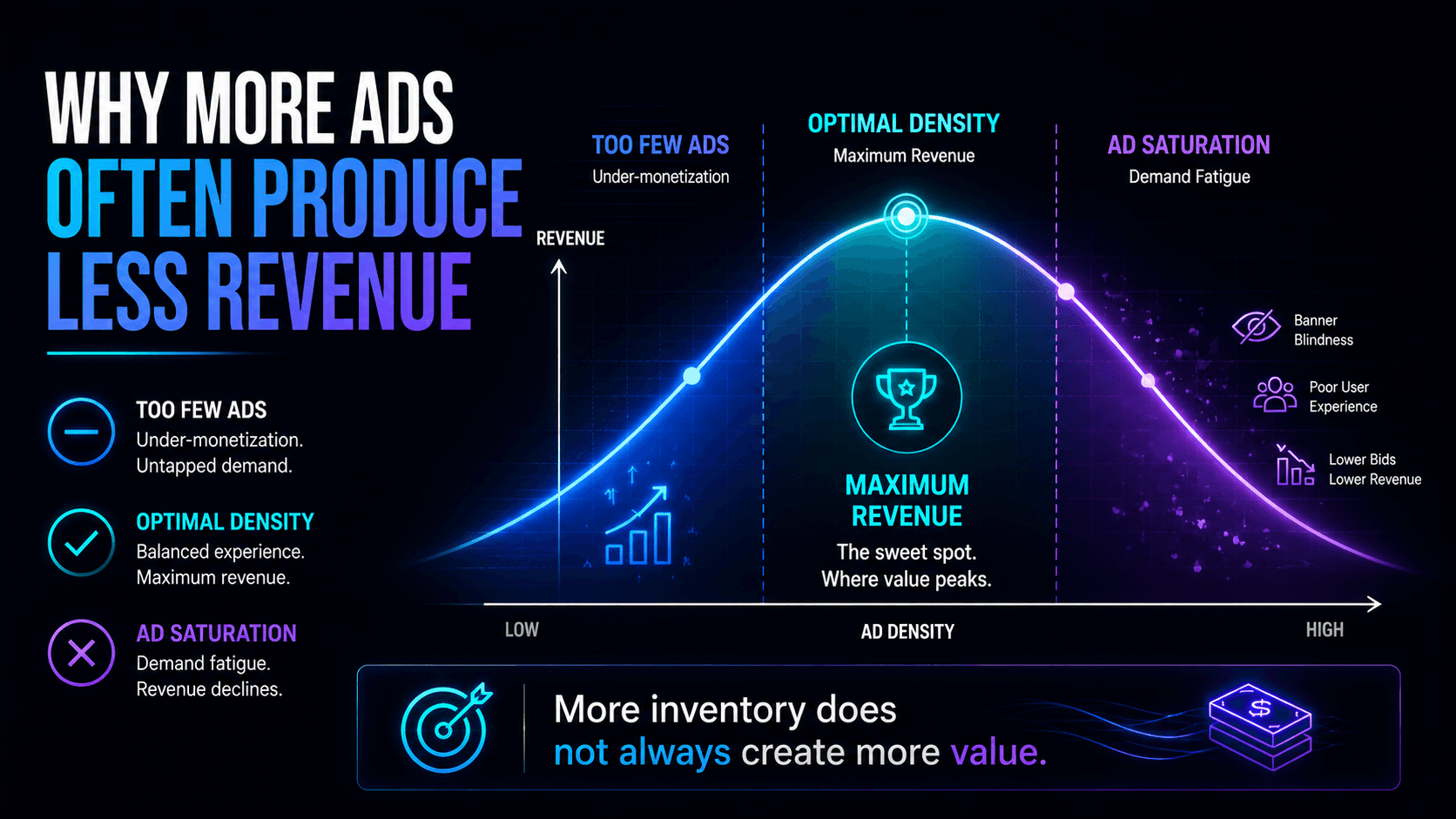
Revenue Curves Are Rarely Linear
One of the most common misconceptions in publisher monetization is the assumption that revenue scales linearly with inventory.
In reality, revenue often follows a curve.
Initially, adding inventory can increase revenue.
Then performance reaches an optimal zone.
Beyond that point, additional inventory begins reducing the value of existing placements.
The curve starts to flatten.
Eventually it can decline.
The goal is not to maximize inventory.
The goal is to maximize value.
These are not the same thing.
Quality Beats Quantity
Many of the highest-performing publishers focus less on creating additional impressions and more on improving existing opportunities.
They optimize:
- Placement quality
- Viewability
- Attention
- Content integration
- User experience
- Demand competition
Rather than asking:
"How many ads can we fit?"
They ask:
"Which opportunities create the most value?"
This shift changes monetization strategy entirely.
Revenue becomes a function of quality rather than volume.
A Better Approach to Growth
Sustainable monetization growth comes from improving inventory quality.
This may include:
- Better placement positioning
- Improved attention signals
- Smarter refresh logic
- Faster page performance
- Reduced layout shifts
- Stronger demand competition
These improvements create value without necessarily increasing inventory.
In many cases, fewer but better opportunities outperform larger quantities of weaker impressions.
Conclusion
Adding more ads can increase impressions.
It can also reduce attention, weaken competition, and create a poorer user experience.
Revenue optimization is not about filling every available space with advertising.
It is about identifying the opportunities that create the greatest value for users, advertisers, and publishers simultaneously.
The most successful monetization strategies focus on quality rather than quantity.
Because more inventory does not always create more value.