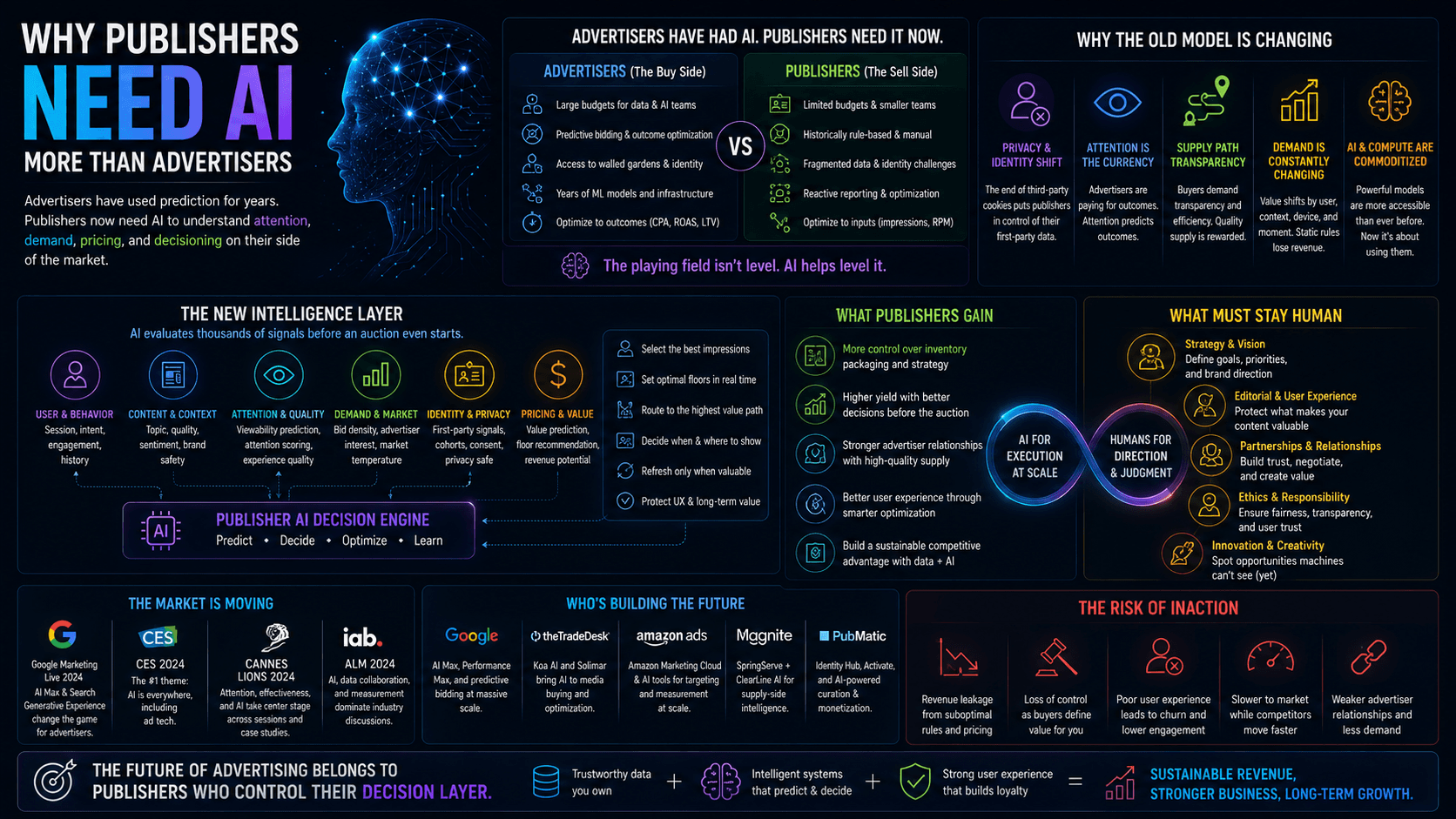
Artificial intelligence is often discussed as the next major force in advertising.
In reality, AI has already been transforming the industry for years.
The difference is that most of that transformation happened on the buy side.
Large advertisers, DSPs, and walled gardens have spent more than a decade building systems that predict user behavior, optimize bidding decisions, allocate budgets, and evaluate campaign performance in real time.
Publishers are only beginning that journey.
As the advertising market becomes more competitive and more complex, publishers increasingly face a difficult reality:
Advertisers already have intelligent systems.
Publishers now need them too.
AI Already Powers Modern Advertising
When a bidder decides how much to pay for an impression, that decision is rarely manual.
Modern DSPs evaluate hundreds of signals in milliseconds:
- User behavior
- Device characteristics
- Location
- Historical performance
- Contextual relevance
- Conversion probability
- Campaign objectives
The bid returned by a DSP is often the result of predictive models that estimate future outcomes.
Companies such as Google's DV360, The Trade Desk, Amazon Ads, and Meta have invested billions of dollars into systems that continuously learn and optimize.
For years, the buy side has competed using prediction.
The sell side has largely competed using configuration.
Why Publishers Are Falling Behind
While advertisers embraced predictive systems, many publisher workflows remained surprisingly static.
Examples include:
- Fixed floor prices
- Static placement rules
- Universal refresh intervals
- Generic routing decisions
- One-size-fits-all layouts
These rules may have worked when inventory was simpler and demand was more predictable.
Today's market is fundamentally different.
The value of an impression can change dramatically depending on:
- User attention
- Content quality
- Demand competition
- Device type
- Session behavior
- Market conditions
Static rules cannot react to this complexity.
Publishers need systems that can.
The Industry Is Entering a New Phase
Several major developments are accelerating the shift toward publisher-side intelligence.
The End of Easy Identity
The gradual decline of third-party cookies forced the industry to rethink targeting and measurement.
Publishers suddenly became responsible for understanding and activating their own signals.
First-party data moved from a supporting asset to a strategic advantage.
Attention Becomes a Currency
The industry increasingly recognizes that visibility alone does not explain value.
Research from companies such as Adelaide, Lumen, Amplified Intelligence, and others has pushed attention measurement into mainstream advertising discussions.
Advertisers are asking a new question:
"Was the ad seen?"
is being replaced by:
"Was the ad actually noticed?"
This creates a significant opportunity for publishers that can understand attention before the auction begins.
Supply Path Optimization
Large buyers increasingly evaluate not only inventory quality but also the path used to access it.
Supply Path Optimization (SPO) initiatives have encouraged advertisers to reduce unnecessary intermediaries and favor trusted supply relationships.
This means publishers must understand not only inventory quality but also how inventory reaches buyers.
The Rise of Sell-Side Intelligence
Perhaps the most important shift is the emergence of predictive systems on the publisher side.
Instead of waiting for buyers to determine value, publishers are beginning to build their own valuation models.
This changes the economics of monetization.
What AI Can Actually Do for Publishers
Artificial intelligence is often discussed in abstract terms.
For publishers, the applications are surprisingly practical.
Predict Inventory Value
Before an auction starts, a model can estimate:
- Expected viewability
- Expected attention
- Expected engagement
- Demand probability
- Revenue potential
Not all impressions deserve identical treatment.
Prediction helps identify which opportunities matter most.
Optimize Placement Decisions
AI can determine:
- When inventory should load
- Where inventory should appear
- Which users should receive which experiences
Instead of fixed placement rules, inventory becomes adaptive.
Improve Floor Pricing
Most floor strategies remain reactive.
Publishers observe performance and then make adjustments.
Predictive systems allow floors to respond dynamically to market conditions and expected value.
Protect User Experience
Optimization is not only about revenue.
AI can help balance:
- Ad density
- Layout stability
- Session quality
- Content consumption
- Revenue generation
This creates a healthier long-term relationship between monetization and user experience.
The Next Evolution: Publisher Decision Systems
The future is not simply automation.
The future is decision-making.
The most advanced publisher systems will continuously evaluate signals and answer questions such as:
- Should this impression exist?
- How valuable is it?
- What floor should apply?
- Which demand path creates the highest value?
- Should it refresh?
- Should it wait?
These decisions happen before revenue is created or lost.
This is the foundation of modern sell-side decisioning.
What Must Stay Human
Despite rapid advances in AI, strategy remains a human responsibility.
Machines can optimize.
Humans decide what matters.
Publisher teams will continue defining:
- Business objectives
- User experience standards
- Editorial priorities
- Brand requirements
- Revenue strategies
AI becomes a decision engine, not a replacement for leadership.
The strongest organizations will combine human judgment with machine-scale execution.
The Publishers That Win
The next generation of successful publishers will not necessarily have the largest audiences.
They will have the best understanding of value.
They will know:
- Which impressions matter
- Which users create opportunity
- Which placements deserve protection
- Which decisions increase long-term revenue
Most importantly, they will control the intelligence layer themselves.
Conclusion
Advertisers have spent years using prediction to gain competitive advantages.
Publishers now face the same opportunity.
The future of advertising will belong to organizations that understand attention, demand, context, and value before an auction begins.
The industry is moving beyond measurement and into decision-making.
Publishers that embrace intelligent systems will gain more control over pricing, inventory quality, user experience, and long-term growth.
Because in the next era of advertising, the most valuable asset will not be data.
It will be the ability to make better decisions with it.