Revenue Intelligence

Why Viewability Alone Is Not Enough

4 min read
Why Viewability Alone Is Not Enough

Viewability became one of the most important metrics in digital advertising. Yet publishers who optimize exclusively for viewability often discover a frustrating reality: two placements with identical viewability scores can generate dramatically different revenue.

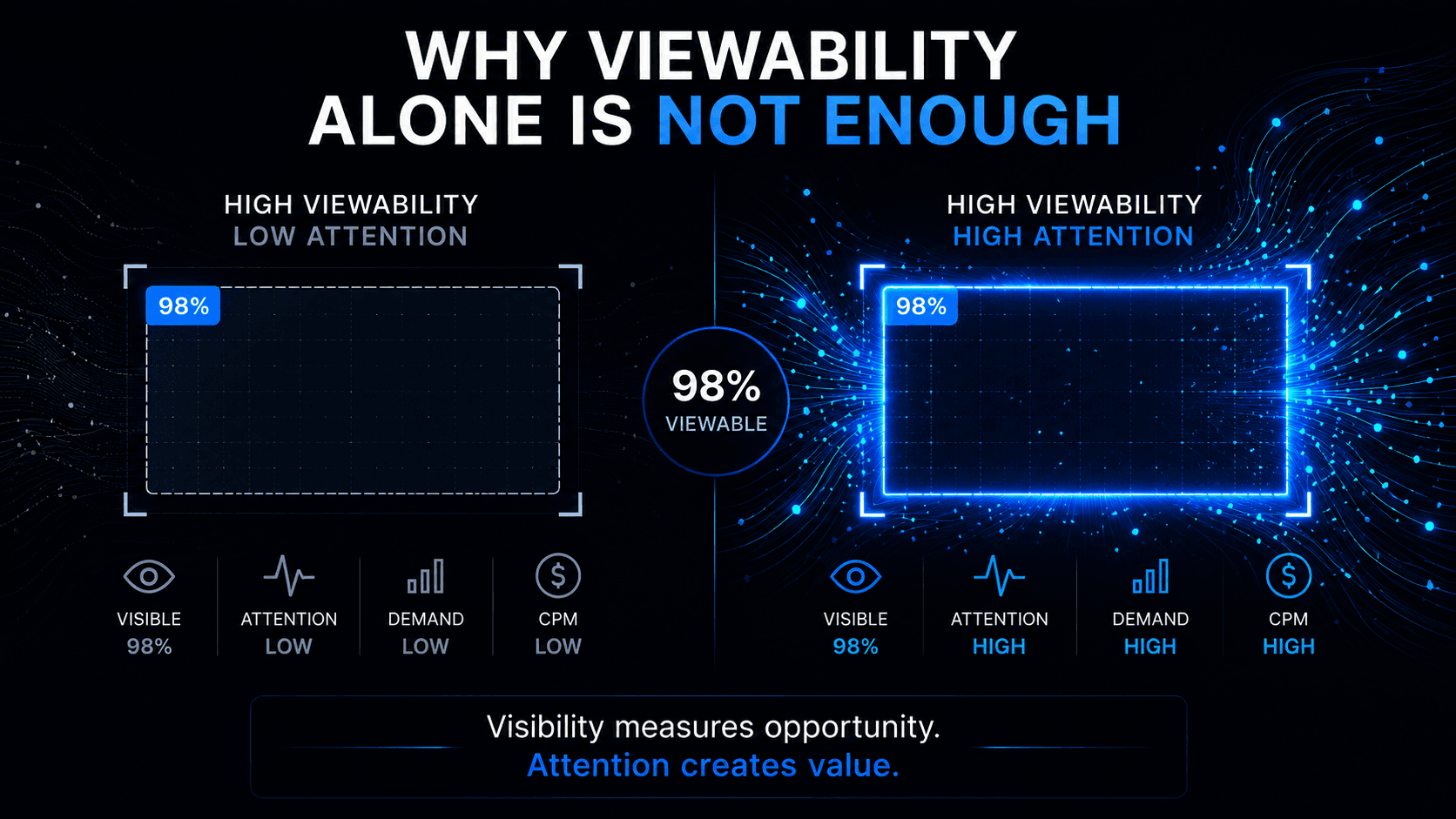
If one ad achieves 98% viewability and another achieves 98% viewability, why does one consistently earn 5–10x more CPM?

The answer is simple:

Viewability measures opportunity. Revenue depends on demand.

And demand is influenced by far more than whether an ad appeared on screen.


The Industry's Obsession With Viewability


For years, publishers have focused on improving viewability rates.

The logic is sound:

  • Higher viewability improves advertiser outcomes
  • Many DSPs optimize toward viewable inventory
  • Better viewability often correlates with higher CPMs

    According to the standards defined by the Interactive Advertising Bureau and Media Rating Council, a display ad is generally considered viewable when at least 50% of its pixels remain visible for one continuous second.

    This metric became a useful baseline for measuring inventory quality.

    But a baseline is not a valuation model.


The 98% Viewability Paradox


Imagine two ad placements.

Placement A

  • 98% viewability
  • User actively reading
  • Low scroll velocity
  • Long dwell time
  • High attention probability
  • Strong historical CTR

Placement B

  • 98% viewability
  • User rapidly scrolling
  • Low engagement
  • Short session duration
  • Weak historical performance

    From a viewability perspective, both placements appear identical.

    From a buyer's perspective, they are completely different products.

    One represents a highly engaged user at a meaningful moment.

    The other represents an impression that merely happened to be visible.

    Yet traditional monetization systems frequently treat both placements the same.


Viewability Is Binary. Attention Is Not.


Viewability answers a simple question:

Was the ad visible?

It does not answer:
  • Was the user paying attention?
  • Were they reading?
  • Were they scanning?
  • Were they about to leave the page?
  • Were they interacting with content?
  • Were they likely to click?
  • Were they likely to remember the ad?

    These signals exist on a spectrum.

    Two placements can both be viewable while delivering vastly different outcomes for advertisers.

    This is where attention-based measurement begins to matter.


The Missing Layer: Behavioral Context


Modern publishers generate enormous amounts of behavioral information.

Examples include:

  • Reading pace
  • Scroll velocity
  • Dwell time
  • Interaction frequency
  • Content completion
  • Session depth
  • Return visits
  • Device characteristics

    Individually, these signals may seem weak.

    Combined, they create a much richer picture of inventory quality than viewability alone.

    A placement viewed by an engaged reader for 12 seconds is fundamentally different from one viewed during a rapid scroll.

    Both may satisfy viewability requirements.

    Only one is likely to command premium demand.


Demand Does Not Buy Viewability. Demand Buys Outcomes.


Advertisers ultimately care about results.

Those results may include:

  • Brand recall
  • Click-through rate
  • Conversions
  • Video completion
  • Attention
  • Reach within valuable audiences

    Viewability is one input into those outcomes.

    It is not the outcome itself.

    This distinction matters because publishers often optimize for the metric instead of optimizing for value.

    Increasing viewability from 75% to 95% may produce meaningful gains.

    Increasing it from 95% to 99% may produce almost no additional revenue if the underlying attention quality remains unchanged.


Why Premium Inventory Is More Than Placement


Historically, premium inventory was defined by location.

Above-the-fold placements were considered valuable because they were more likely to be seen.

Today, premium inventory is increasingly defined by context.

A mid-article placement may outperform a top-of-page placement if:

  • The user is deeply engaged
  • Attention levels are high
  • Reading behavior is stable
  • Demand competition is strong

    The market is gradually moving from position-based valuation toward context-based valuation.

    Publishers who recognize this shift gain a significant advantage.


The Next Evolution: Predictive Inventory Valuation


The most sophisticated monetization systems no longer ask:

"Is this placement viewable?"

Instead they ask:

"How valuable is this impression likely to be before the auction begins?"

This introduces additional layers of intelligence:
  • Predicted viewability
  • Predicted attention
  • Predicted CTR
  • Historical demand patterns
  • Competition levels
  • User engagement signals
  • Content quality indicators

    Together, these signals create a more complete estimate of inventory value.

    Rather than reacting to auction outcomes, publishers can begin making decisions proactively.


What Publishers Should Measure


Viewability remains important.

Ignoring it would be a mistake.

But relying on it as the primary measure of inventory quality leaves substantial revenue on the table.

Publishers should increasingly evaluate:

  1. Viewability
  2. Attention
  3. Engagement
  4. Demand competition
  5. Historical performance
  6. Predicted value

    The combination of these signals provides a far more accurate picture of inventory quality than any single metric alone.


Conclusion


Viewability helped the industry move beyond simple impression counting.

It remains a critical metric.

But it was never designed to explain why one impression earns $0.50 CPM while another earns $5.00 CPM.

As programmatic advertising becomes more intelligent, publishers must move beyond visibility and begin understanding value.

Because in modern auctions, being seen is only the beginning.

The real question is whether the impression deserves attention, attracts demand, and creates outcomes.

And that requires looking beyond viewability alone.


Key Takeaway

Viewability measures whether an ad had the opportunity to be seen. Revenue depends on whether that opportunity is valuable to buyers. The future of publisher monetization lies in combining viewability with attention, engagement, and predictive intelligence.