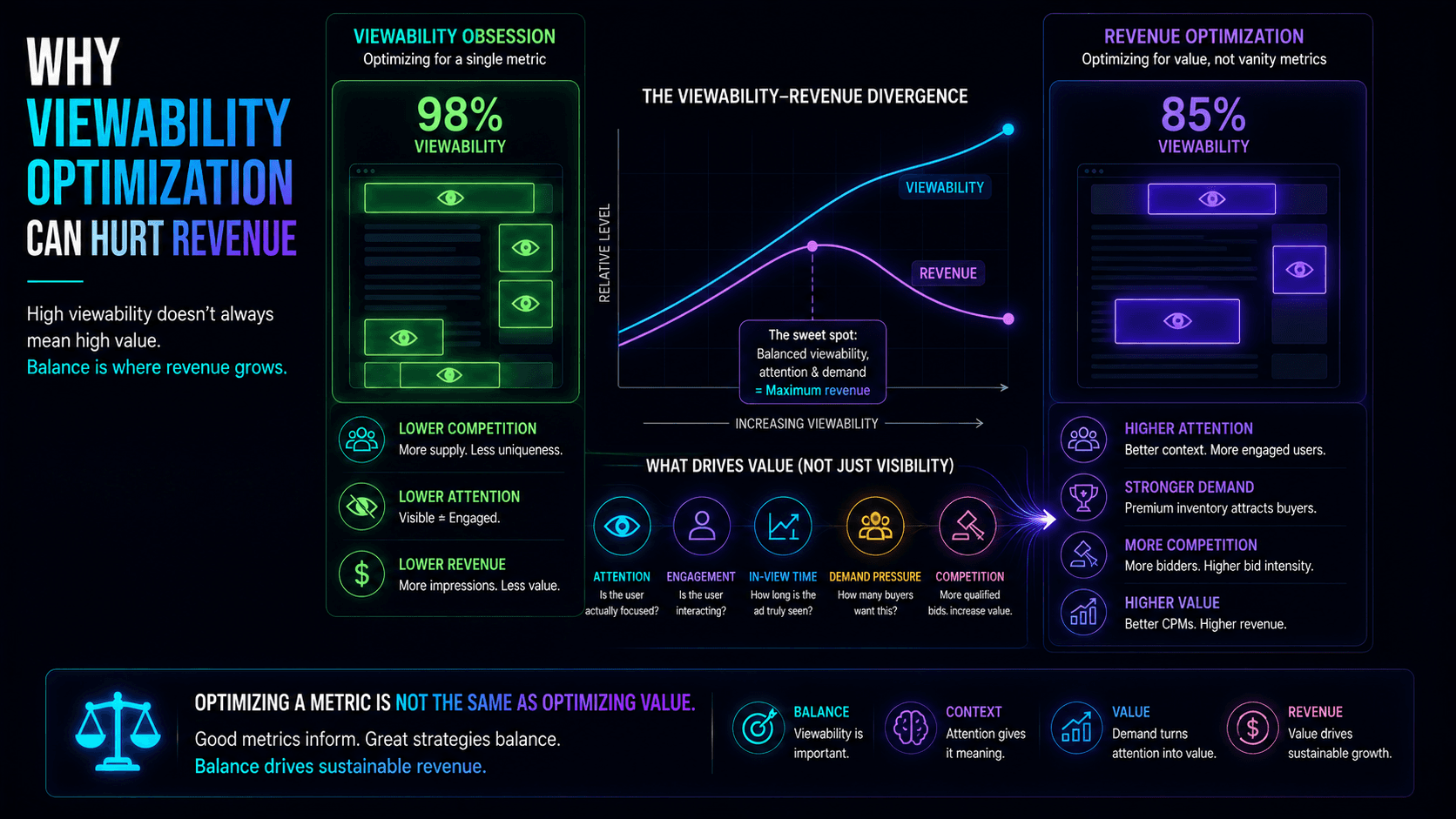
Why Viewability Optimization Can Hurt Revenue
For more than a decade, viewability has been one of the most important metrics in digital advertising.
The logic seems obvious.
If users cannot see an ad, advertisers receive little value.
Therefore, improving viewability should improve performance.
In many cases, it does.
However, a surprising number of publishers discover that aggressively optimizing for viewability does not always increase revenue.
Sometimes it does the opposite.
The reason is simple.
Viewability is an important signal.
It is not the same thing as value.
When publishers optimize exclusively for viewability, they often create unintended consequences that reduce attention, weaken demand, and lower the overall value of their inventory.
Why Viewability Became Important
Viewability emerged as a response to a real industry problem.
Advertisers were paying for impressions that users never had a chance to see.
As a result, viewability became a trusted measurement standard.
A viewable impression generally means:
- The ad entered the viewport
- A sufficient portion was visible
- The visibility lasted for a minimum duration
This represented a significant improvement over simply counting impressions.
The industry moved from measuring delivery to measuring visibility.
That was progress.
But visibility alone is not enough.
The Metric Trap
A common mistake in optimization is confusing a metric with the outcome it represents.
Viewability is valuable because it increases the probability of attention.
It does not guarantee attention.
A user can technically see an ad while completely ignoring it.
Consider two placements:
Placement A
- 98% viewability
- Minimal engagement
- Low attention
- Weak advertiser performance
Placement B
- 85% viewability
- Strong attention
- Longer in-view time
- Better advertiser outcomes
Which placement creates more value?
In many cases, the second placement wins.
Despite having lower viewability.
When Viewability Optimization Goes Too Far
Publishers sometimes make design decisions solely to improve viewability scores.
Examples include:
- Excessive sticky units
- Aggressive floating ads
- Overly persistent placements
- Artificial exposure strategies
These tactics often increase visibility.
They can also create:
- User frustration
- Reduced engagement
- Faster exits
- Banner blindness
- Lower advertiser effectiveness
The metric improves.
The experience declines.
Attention Matters More
Attention is what advertisers actually care about.
Visibility creates an opportunity.
Attention determines whether that opportunity produces results.
An impression becomes valuable when users:
- Notice it
- Process it
- Engage with it
- Remember it
Attention transforms visibility into performance.
This is why two placements with similar viewability can generate dramatically different outcomes.
The difference is often attention.
Demand Responds to Outcomes
Advertisers continuously evaluate performance.
When inventory generates strong outcomes, demand increases.
When inventory produces weak outcomes, demand often becomes more conservative.
The market does not bid aggressively simply because an impression is viewable.
It bids aggressively when the inventory performs.
Performance depends on multiple factors:
- Attention
- Engagement
- Context
- Audience quality
- In-view time
- Historical results
Viewability is only one component of a much larger valuation model.
The Hidden Cost of Chasing 100%
Many publishers treat higher viewability as an always-positive objective.
However, the relationship between viewability and revenue is rarely linear.
There is often an optimal range where:
- Visibility is strong
- User experience remains healthy
- Attention stays high
- Advertiser performance improves
Beyond that point, forcing additional visibility may create diminishing returns.
Revenue growth slows.
In some cases, revenue begins to decline.
The metric continues improving while value decreases.
Better Signals for Optimization
Modern monetization strategies increasingly incorporate signals beyond viewability.
Important examples include:
Attention
How much meaningful focus does the impression receive?
Engagement
How actively is the user interacting with content?
In-View Time
How long does the placement remain visible?
Demand Pressure
How aggressively are buyers competing?
Historical Performance
How consistently does the placement generate outcomes?
Together, these signals provide a more complete picture of inventory value.
Optimize for Value, Not Metrics
The goal of monetization is not to maximize individual metrics.
The goal is to maximize value.
Value emerges when multiple factors align:
- Visibility
- Attention
- Engagement
- Demand
- Context
Optimizing one signal while ignoring the others often creates blind spots.
The strongest publishers evaluate inventory holistically rather than relying on a single measurement.
A Better Framework
Instead of asking:
"How can we increase viewability?"
Ask:
"How can we increase inventory value?"
That question naturally expands the optimization process.
Viewability remains important.
It simply becomes one input among many.
The result is better inventory quality, stronger advertiser performance, and healthier long-term revenue growth.
Conclusion
Viewability remains one of the most important measurements in digital advertising.
But it is not the same thing as value.
Publishers that optimize exclusively for viewability often discover that higher scores do not automatically produce better outcomes.
Revenue depends on attention, engagement, demand, context, and performance.
Visibility matters.
Value matters more.
The most effective monetization strategies optimize for outcomes rather than individual metrics.